
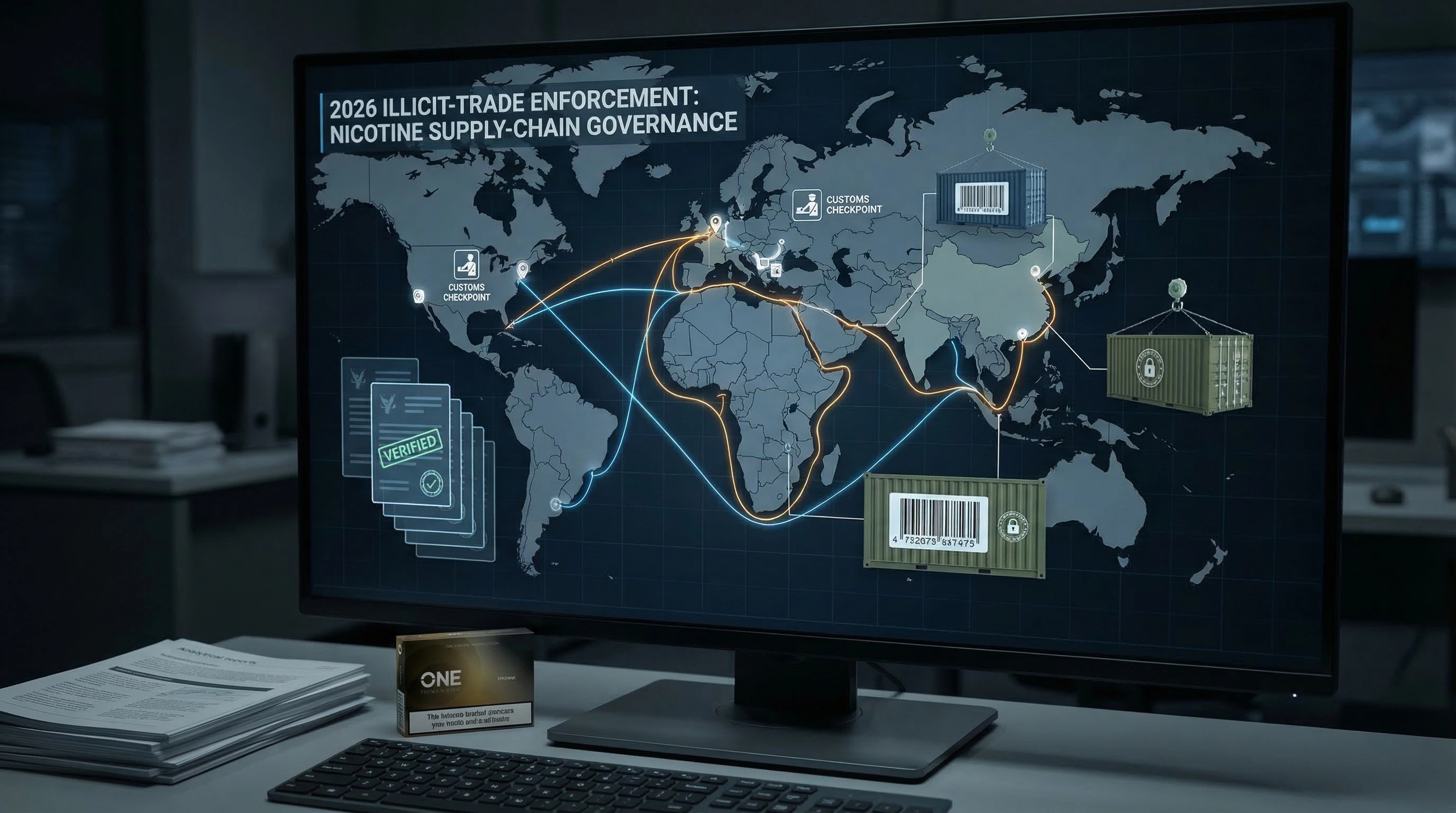
Illicit trade is no longer just an enforcement headline. In 2026, it is increasingly a strategic business variable that affects compliance planning, channel confidence, revenue assumptions, and brand-safe market participation across the nicotine sector. Recent developments in Australia and the United States underline the same point from different directions: authorities are escalating pressure on unauthorized products, and companies are being forced to think harder about traceability, import pathways, and market legitimacy.
In Australia, the Australian Border Force said Operation TEMPEST26 was a multi-phase joint-agency effort to detect, deter, and disrupt illicit tobacco networks in Queensland and South Australia. Official ABF material says the operation targeted networks threatening Australia's borders and community, while a separate ABF update in February said illicit tobacco and vapes representing AUD 1 billion in evaded duty had been stopped at the border in a single quarter, including more than 467 tonnes of illicit cigarettes and loose-leaf tobacco combined.
These are not marginal numbers. They show that illicit supply is being treated as both a border-security issue and a market-governance issue. That has direct implications for lawful operators. Where enforcement intensifies, distributors, manufacturers, and retail partners face greater expectations around due diligence, source validation, documentation, and the ability to distinguish authorized product flows from suspect ones.
The U.S. picture is different in structure but similar in implication. Reuters reported in February that BAT estimated unregulated devices made up about 70% of U.S. e-cigarette sales and said a potential U.S. import block on certain disposable vapes could reduce that unregulated market by roughly a third, though meaningful impact would likely not arrive before 2027 because of inventory and supply-chain lag.
Meanwhile, the FDA's own enforcement page says the agency has issued more than 700 warning letters to firms involved with unauthorized new tobacco products and more than 800 warning letters to retailers for selling unauthorized tobacco products. Whatever the eventual outcome of trade cases or import restrictions, the broader market signal is already visible: regulators and border-related actors are increasingly focused on how products enter, move through, and remain in the market.
For OTI-style corporate communications, the relevant angle is not alarmism. It is governance. Businesses can talk credibly about illicit-trade pressure in terms of compliance architecture: customs awareness, product authentication, packaging controls, documentation integrity, supplier qualification, and route-to-market discipline. That is a more useful narrative than simply repeating seizure numbers, because it explains what responsible operators can actually do in response. The policy conversation is moving from enforcement after the fact toward stronger systems before the fact. That is where corporate preparedness becomes visible.
In practice, that means strengthening traceability at the carton and case level, improving records for import and distribution partners, reviewing packaging elements that support authentication, and aligning internal teams around the same definition of market-ready compliance. As illicit-trade risks and enforcement capacity continue to evolve, supply-chain governance is becoming part of brand protection, not separate from it.
The broader lesson for 2026 is that lawful market participation increasingly depends on proof, not assumption. Companies that can document where products came from, how they were handled, and why they meet market requirements will be better placed to navigate both regulators and counterparties. In a fragmented environment, trust is operational.
Source: Australian Border Force — National Disruption Group nets millions with major multi-state success